
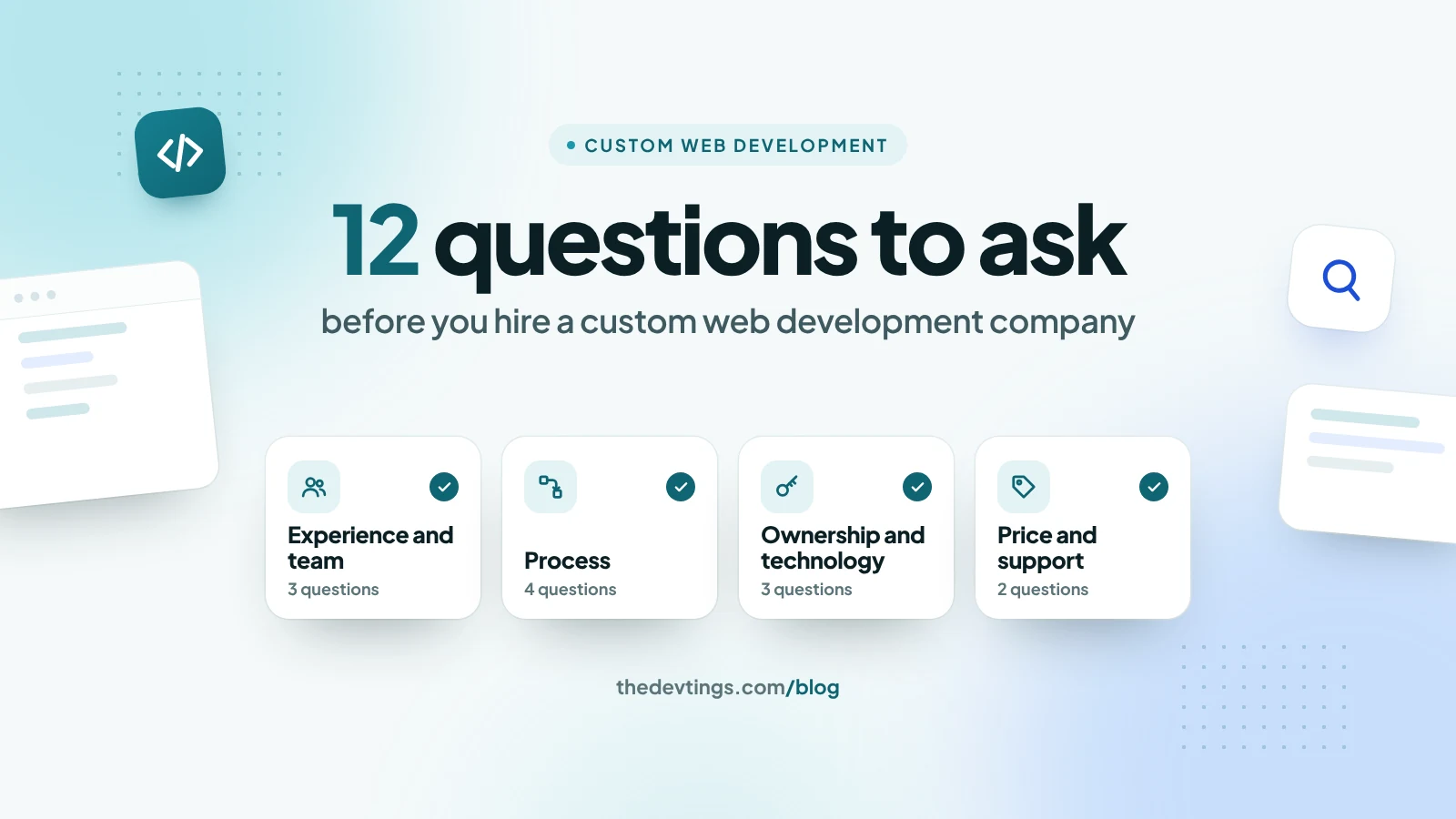
Choosing a custom web development company is one of the bigger decisions a small business makes. The right team builds a website or web app that does exactly what your business needs and keeps working for years. The wrong one can cost you months, and a second budget to fix it. This guide shows how to choose a custom web development company: what custom development should give you, 12 questions to ask before you sign, the red flags to watch for, and how to compare proposals.
What a custom web development company should give you
Custom web development means your website or web application is designed and coded for your business, rather than assembled from a ready-made theme or a site builder. Done well, it gives you:
- Features built around how you work, such as bookings with your own rules, quote calculators, customer accounts or a client portal.
- Connections to the tools you already use, like your CRM, accounting software, stock system or payment provider.
- Speed and search visibility that a heavy theme with dozens of plugins struggles to match.
- Ownership. The code, the data and the accounts are yours, so you can change developers without starting again.
Not every business needs custom work. A good company will tell you when a website builder or a WordPress or Shopify theme is enough for now.
12 questions to ask before you hire
Ask every company on your shortlist the same questions, and ask for the answers in writing. Written answers are easier to compare than sales calls.
Experience and team
- 1. Have you built something like this before? Ask for two or three live examples close to your project, such as a booking system, a customer portal or a store with custom features, and what the company did on each. A long list of brochure sites says little about building a web application.
- 2. Can I speak to a past client? A short call with a client from a similar project tells you more than any case study: whether deadlines held, how problems were handled, and whether they would hire the team again.
- 3. Who will work on my project? Ask who designs, who builds and who tests, whether they are employees or subcontractors, and who your day-to-day contact is. You want one named person who answers your questions and owns the schedule.
Process
- 4. How will you turn my idea into a written scope? Good companies start with discovery: they ask about your goals, users, features and current tools, then write down what will be built. A fixed price without a written scope is a guess, and the gaps come back later as extra costs.
- 5. How will I see progress? Look for a test version of the site you can click through (a staging site), demos every one or two weeks, and a shared task list. If you only see the work at the end, problems surface when they cost the most to fix.
- 6. What happens when I want to change something? Changes are normal in any project. Ask how they are estimated, approved and billed, so a small request doesn't turn into a surprise invoice.
- 7. How do you test before launch? Ask about testing on different browsers and phones, speed and security checks, and a period for you to try everything before it goes live.
Ownership and technology
- 8. Who owns the code, the domain and the hosting? You should. The code should sit in a repository you can access, and the domain, hosting and other accounts should be in your business's name. Put this in the contract.
- 9. Which technologies will you use, and why? The answer should fit your project, not only the team's habits. Mainstream, well-supported technologies make it easier to hire help later. Be careful with in-house platforms that only the original company can maintain.
- 10. How will you protect my data and my customers' data? Ask about secure logins, encrypted connections (HTTPS), backups, who can access what, and how the site will meet the privacy rules that apply to you, such as UK GDPR or US state privacy laws.
Price and support
- 11. What exactly does the price include? Check design, development, content entry, hosting, licences, training and launch support. Ask whether the price is fixed or billed by time, how payments are split across milestones, and what the site will cost to run each year.
- 12. What happens after launch? Ask how long bugs are fixed free of charge, what a maintenance plan covers, how fast the team responds to problems, and who installs software and security updates.
Red flags
- A firm price before anyone has asked about your business or written a scope.
- No contract, or a contract that doesn't say who owns the code.
- The domain or hosting registered in the developer's name.
- No staging site and no regular demos.
- Promises of "first place on Google". Nobody can guarantee rankings.
- A price far below the others with vague deliverables. The difference usually comes back as change requests.
How to compare proposals
With two or three proposals in hand, put them side by side and check:
- Scope: do they describe the same features, in enough detail to compare?
- Timeline: are there milestones with dates, and what does each one need from you?
- Cost over two years: the build plus hosting, licences and maintenance, not only the first invoice.
- Ownership and exit: can you take the code to another team without a fee?
- Support: response times and what is covered after launch.
The cheapest proposal is rarely the cheapest project. The one with the clearest scope usually is.
Questions people ask
How long does custom web development take? As a rough guide, a marketing website takes 4 to 8 weeks, a website with custom features 2 to 4 months, and the first version of a web application 3 to 6 months. Your proposal should give dates for your own project.
Can I work with a company in another country? Many US and UK businesses do. What matters is a few hours of overlap in working time, one named contact, regular demos, and a contract that covers ownership and payment milestones.
Should I choose a fixed price or pay by time? A fixed price suits a project with a clear, written scope. Paying by time suits work that will change as you learn, such as a new product. Either way, ask for an estimate and a cap.
Talk to Devtings
Devtings builds custom websites and web applications for small and mid-size businesses in the US and the UK. Ask us any of the 12 questions above. See our custom web development services or get in touch.